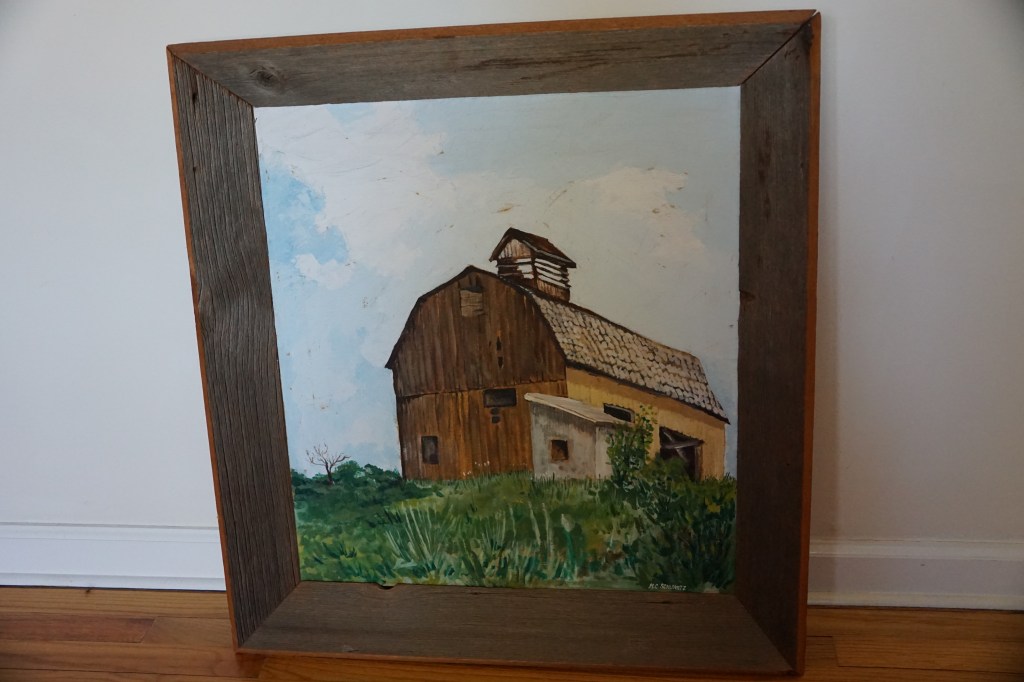
My father painted this image sometime in my childhood. He worked on it for two sittings with his easel and oil paints. I have been looking at this picture for what seems like my entire life. Recently, my brother took the painting down while work was being performed on the wall behind where the canvas hung. I missed this image and starting thinking about the barn. I grew up in place that does not exist anymore. That happens everywhere and to everyone. Buildings and trees and homes slip away from the landscape into creeping oblivion, lost forever with the last person who recalls them or when the last document or record of its existence degrades to nothing in landfill and fire. The layering in physical space whether engineered or organic, covers up what once was. The field is not there anymore. Nor the grass, the barn, the solitary tree. They have all been replaced with a lot, a chain link fence. So now it is this. It serves as this existential palimpsest. We cover up the landscape with one thing over another. It was once a barn and now is an empty lot. It once was a movie theatre and now is a grocery store. It was once a lake and is now a landfill, an inversion of space. The existential palimpsest that lingers behind the new is residue, at first in dirt and dust and then molecules, atoms, particles of the shifting temporal features. And, if we are lucky, the traces that mark the space push inward, into the long-term workings of the neocortex, where memory deteriorates unexceptionally. In some cases, we can counteract that pattern with the corroboration to be found in a photograph, a drawing, a painting.
I moved the painting into a room with sunlight and thought about that day it was painted. My father fixed the barn on canvas. He created a proxy for it. Two weeks after he painted this image, the barn was torn down. That layer is gone forever, only living on in facsimile. In memory or documentation, the facsimile then becomes the thing. This painting. And to add more confusion to this ethereal inquiry, the wooden frame for this work was made by a neighbor who salvaged wood from the barn before it was demolished.
I drove past another transformed space the other day from my childhood. It once was a small pond surrounded by overgrowth where we spent many hours ice skating in my childhood. The pond is gone now. The overgrowth removed; the water gone. It is now an extension of someone’s lawn. I have no record of that place; only in memory. If I wandered onto that corner of lawn and started to dig, would I find evidence of what came before? If I moved enough earth would I uncover a lost layer, the rock where I sat to tie my skates or that mound of dirt on the edge of a once frozen body where I would have stood so many years ago?
 Holly Martins' Friend